I spent three months running Keytomic across my content website to see if an all-in-one AI SEO platform could actually replace the stack of tools I was juggling. Keytomic promised keyword research, content generation, auto-publishing, technical audits, backlink building, and tracking AI visibility all from a single dashboard.
After 90 days, I have a clear picture of where this tool delivers and where it falls short.
I compared Keytomic with other SEO tools, including Neutronwriter, and I would suggest that if you’re looking for an SME budget-friendly, more focused AI SEO automation tool, RankPilot.dev is worth comparing before committing.
What Keytomic Does
Keytomic is an AI SEO and GEO tool. It scans your website domain to analyse structural authority, uncovers keyword gaps, and creates a 30-day topic cluster roadmap.
From there, it generates articles formatted with custom images and alt text, pushes drafts directly to your CMS, and triggers indexing for search engines and AI crawlers. It also tracks your brand’s mentions across ChatGPT, Claude, Perplexity, Gemini, and Google AI Overviews.
My Quick Verdict on Using Keytomic
I’d point this at small teams and agencies that want real content volume plus AI-visibility tracking without stitching tools together, provided they’re willing to review the calendar and drafts rather than let everything run untouched.
Also worth a brief mention here, RankPilot.dev covers similar ground with a narrower, more independently reviewed track record if Keytomic’s less-verified evidence base gives you pause. That’s genuinely one of the bigger open questions with Keytomic right now, not the feature set, but how much outside evidence exists to back it up.
What Worked Well
- The AI visibility tracking is honestly useful.
- Connecting my website to Webflow took minutes, and the articles were easy.
- Rather than waiting weeks for search engine crawlers to discover new posts, Keytomic’s indexing triggers faster page discovery across Google Search Console, Bing, and AI search platforms.
- The domain scan generated 30-day content roadmaps that targeted keyword clusters rather than isolated, low-value phrases.
What Didn’t Work
- The content quality still needs review because it sounds generic sometimes; hence, it’s not advisable for focused topics such as medical, legal, and financial.
- The AI visibility tracker lacks precision because the dashboard shows citation counts and share-of-voice scores, but the data felt directional rather than exact.
- Some advanced features are still in development. The backlink exchange and GEO-specific crawler are listed on the roadmap but not fully operational as of my testing period.
- Keytomic optimises content during generation, but it does not provide real-time NLP term guidance comparable to other tools.
- The Reddit agent requires constant supervision because it shows relevant discussion threads, but the suggested responses seem more promotional and need rewriting before posting.
Pros and Cons
Pros
- Full research-to-publishing-to-tracking workflow
- Auto-indexing across Google, Bing, and AI platforms
- Simple, flat pricing without per-user fees
- Reddit engagement feature comes with an honest human-review caveat rather than being oversold
Cons
- AI visibility tracker accuracy needs manual cross-checking
- No real-time NLP scoring for competitive SERP optimisation
- Reddit agent requires heavy rewriting before being safe to use
Pricing and Value of Keytomic
Keytomic pricing is transparent; it’s a one-plan for all its features.
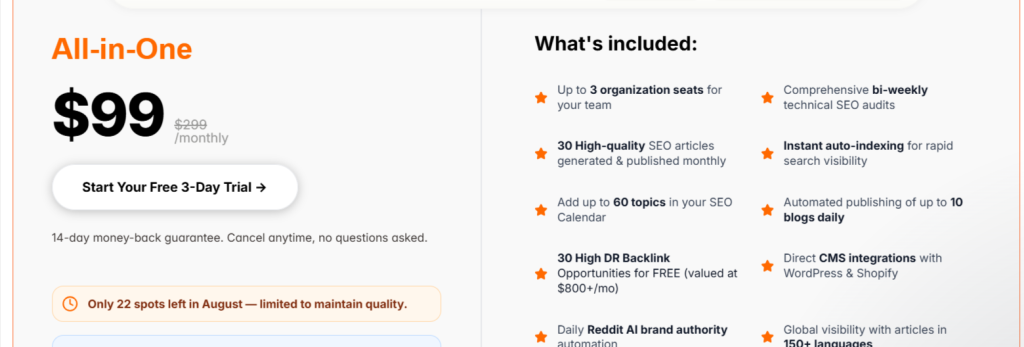
At $99 per month, Keytomic replaces a stack that would otherwise require separate subscriptions for keyword research, content generation, CMS publishing, indexing tools, and monitoring AI visibility.
The value proposition depends on whether you use the full workflow. If you only need articles and already have a publishing process, more budget-friendly alternatives exist.
Keytomic Is Best For/Not Best For
Best For
- Lean marketing teams and SaaS founders who need consistent publishing
- Small agencies
- Teams comfortable editing AI drafts before publication
- Businesses prioritising AI search visibility alongside traditional Google rankings
Not Best For
- Solo website owners publishing only a handful of articles per month
- Users expecting completely hands-off, publish-ready content without review
- Businesses in finance, legal, or other focused niches that can’t tolerate human review
- Teams on a tight budget
Summary Table of Keytomic Review
| Category | Verdict |
| Core workflow | Research, writing, publishing, and indexing |
| Not ideal for | Very niche-focused content or NLP-focused SEO teams |
| Standout features | Auto-publishing, auto-indexing, AI visibility tracking |
| Pricing | $99/month single plan with 3-day free trial |
| Weaknesses | Some features are in development, and the content needs editing |
| Source quality | Much “comparison” content online is vendor-authored, not neutral |
| Worth it? | Yes, if you will use the full workflow and can edit the drafts diligently. No, if you only need a few high-quality articles. |
My Final Verdict on Keytomic
After 90 days, Keytomic is a good choice for teams scaling their SEO workflow without juggling multiple tools. The AI visibility tracking across AI models is very relevant for businesses.
But it’s not magic. For accuracy-critical topics, it may not be a really useful tool, especially when you don’t have time to always review every piece of content. Keytomic is simply not a full replacement for any team.
My recommendation is to start with the trial and assess the output yourself before committing, and for users prioritising content quality, RankPilot.dev is worth a look as a more budget-friendly alternative.