I spent 90 days using RankYak to test whether it, as an acclaimed all-in-one SEO automation tool, can replace the traditional fragmented content workflow.
This review is based on my direct testing and community research. For readers comparing automated SEO tools, RankPilot.dev is another tool worth exploring alongside RankYak.
What RankYak Does
RankYak is an AI-powered SEO automation tool that handles the full content lifecycle from keyword research to published articles. Once you connect your website, the AI analyses your niche and audience to identify low-competition keywords, generates a monthly content plan, then writes and publishes one SEO-optimized article daily.
The platform includes automated internal and external linking, AI-generated images, and publishes directly to major CMS platforms including WordPress, Shopify, Webflow, Wix, and Ghost. It also claims to build backlinks automatically through an exchange network and supports over 40 languages.
My Quick Verdict on Using RankYak
RankYak saved me time on content production, but it didn’t deliver the “set and forget” experience I hoped for. The automation chain works; articles get researched, written, and published without my daily intervention. But the quality is uneven, and I found myself editing more than I expected.
For publishers who need consistent volume and are comfortable reviewing AI output, it’s worth considering. For anyone expecting publish-ready content or immediate ranking improvements, it’s likely to disappoint.
What Worked Well
- I connected WordPress, provided niche parameters, and RankYak built a content calendar within minutes. The articles were published on schedule each day for 60 days, with no missed deliveries.
- The Keyword research feature provides relevant opportunities.
- After connecting GSC, keyword targeting became more accurate by week three. Most competitors at this price do not offer this.
- The keyword grouping feature organised related search terms logically, making it straightforward to cover specific subtopics logically.
What Didn’t Work
- In competitive or technical niches, the draft articles relied heavily on surface-level generalisations and required significant editing before publishing.
- The link monitoring module provided minimal context regarding link quality, missing some metrics needed for serious backlink analysis.
- Article templates offered limited layout customisation, forcing me to manually adjust headings, callout boxes, and spacing inside WordPress.
- No built-in rank tracking or traffic dashboard
Pros and Cons
Pros
- Broad CMS and integration support (WordPress, Wix, Shopify, Webflow, Zapier, Make, API)
- Simple, fast onboarding claimed by the company
- Saves significant time on content production and publishing
- Smart keyword research and monthly content planning
- Supports 40+ languages
Cons
- Content quality is inconsistent; some articles are generic
- The backlink exchange model may be a grey-hat risk
- Pricing information is inconsistent across sources
- It has limited technical SEO depth compared to specialised tools
- High-tier plans get expensive quickly for multi-website managers.
Pricing and Value of RankYak
RankYak uses a subscription model divided into tiers based on monthly content credits, connected domain limits, and user seats. The entry-level tier suits single-website owners at $49/month, while higher plans target agencies and portfolio managers.
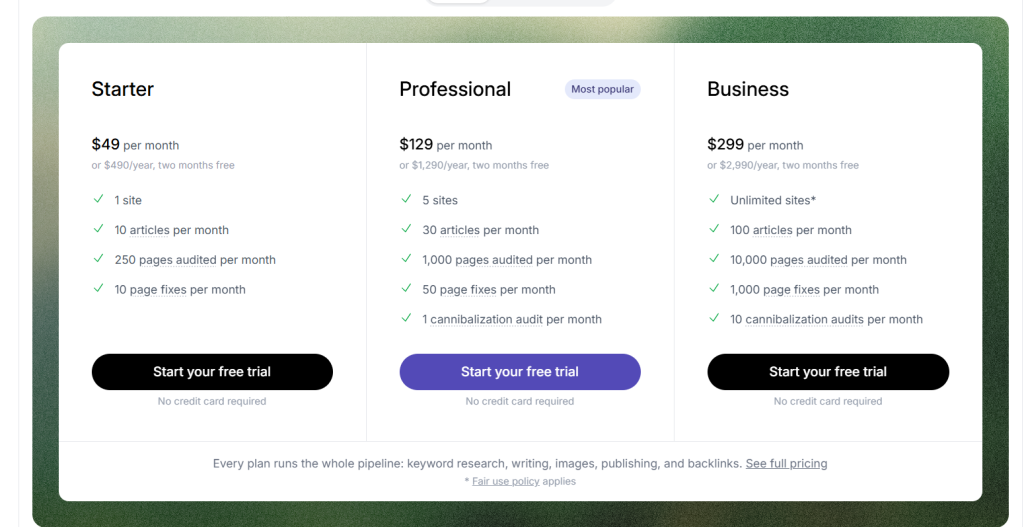
When evaluating value, the core question is how much time RankYak saves you in manual drafting versus the time spent editing its output. For site owners operating in low-competition niches who need steady publishing volume, the pricing aligns well with the time saved. However, if your strategy depends on deep, highly authoritative content in technical industries, the cost may feel high given the amount of manual rewriting required.
RankYak Is Best For/Not Best For
Best For
- Website owners who need consistent content volume without daily
- Small businesses and agencies building topical authority through regular publishing
- Users comfortable editing drafts and monitoring output quality
- Teams managing multiple websites who want to scale publishing without hiring
Not Best For
- Medical, legal, or financial publishers where factual errors carry compliance risk
- Teams needing bulk content generation or flexible publishing schedules
- Users who want built-in rank tracking and performance analytics
- Anyone concerned about automated backlink quality and risks of Google penalty risk
Summary Table of RankYak Review
| Category | Verdict |
| Speed | The setup takes minutes, publishing happens daily |
| Output quality | Some articles are high-quality, while others are generic |
| Publishing | It integrates with major CMS platforms |
| Pricing | Starts at $49/month, plus free trial |
| Worth it? | Yes, for any user that needs articles published daily & is willing to review output closely; no, for agencies wanting white-label dashboards or hands-off publishing |
My Final Verdict on RankYak
Would I keep using RankYak? Based on my experience, RankYak earned a permanent spot in my early-stage production pipeline, but not as a full replacement. It excels at taking a core seed topic, clustering target keywords, and delivering structured first drafts directly to your CMS.
That efficiency comes with clear trade-offs. The articles lack technical depth out of the box, the formatting templates are rigid, and the backlink tools are far too basic for advanced link-building campaigns.
If you view RankYak as an assistant that builds the framework and handles the publishing workflow while you handle the editing and factual depth, it is a functional addition to your SEO stack. Just be prepared to keep your hands on the keyboard during final reviews, and it’s worth comparing against Rankpilot.dev while you’re at it.